Content
In our day-to-day work at a knit mill in Keqiao, the phrase "cotton weaves" turns up in two very different conversations. One is about woven cloth: poplin shirts, denim jeans, sateen bedding, the classic interlacements that have come off looms for centuries. The other is about cotton fabric in general, where "weave" is used loosely to mean "structure", including knit structures that have no warp and weft at all. Both conversations matter, because the words used at the sampling stage decide what eventually arrives in your warehouse.
This guide walks through the woven cotton structures worth knowing, how each one changes the way the cloth behaves, and where cotton knits sit relative to them. We write it from the angle of a fabric supplier that knits rather than weaves, so we will be clear about which side of the line every structure falls on.
Woven fabric is built on a loom from two yarn sets: the warp running lengthwise and the weft running crosswise. A weave is simply the order in which those two sets cross, whether a weft yarn passes over one warp end or under three before it comes back up. Everything else, the yarn count, staple length, twist, dyeing and finishing, sits on top of that basic rhythm.
Three interlacements do almost all of the work:
From these three, mills build the rest. Basketweave groups yarns together, dobby adds small geometric figures, jacquard controls individual warp ends for large patterns, leno twists warp pairs around the weft, and pile fabrics such as corduroy and velvet add a raised surface. One thing is worth keeping straight: a weave name is not a fiber, a yarn or a finish. Poplin is a weave; cotton is a fiber; mercerized is a finish; Ne 40s combed is a yarn specification. When those four categories get mixed up on a spec sheet, sampling becomes slow and expensive.
| Weave | Structure | Handle and behaviour | Common cotton end uses |
|---|---|---|---|
| Plain | One warp over, one weft under | Crisp, firm, balanced, prints cleanly | Poplin shirting, lawn, voile, sheeting, quilting |
| Twill | Floats over two or more ends, diagonal line | Denser, stronger, better drape, hides soil | Denim, chino, gabardine, workwear, canvas |
| Sateen | Long floats, four over one | Smooth lustrous face, soft drape, snag-prone | Bedding, dress shirts, dresses |
| Basketweave and oxford | Yarns grouped two or more as one | Textured, breathable, durable, slightly rough | Button-down shirts, casual shirting |
| Dobby | Small figures on a dobby attachment | Subtle texture, more design room than plain | Shirting, dresses, small-pattern cloth |
| Jacquard | Individual warp end control | Elaborate patterns, heavier, higher cost | Bedding, jackets, upholstery, statement pieces |
| Leno and gauze | Twisted warp pairs around the weft | Open, airy, low abrasion resistance | Summer shirts, gauze, muslin, scarves |
| Seersucker | Plain weave with slack and tensioned stripes | Puckered, no-iron, lifts off the skin | Summer shirts, childrenswear |
| Corduroy and velveteen | Ground weave plus cut or uncut pile | Soft pile, directional, warm | Trousers, jackets, upholstery |
Two caveats before you use this table to specify anything. Within a single row, weight and hand feel can vary enormously: a 120 gsm voile and a 300 gsm canvas are both plain weave. And the finishing route can change behaviour more than the weave itself, which is why a sanforized poplin and a raw poplin feel like different fabrics even when they leave the loom identically.
Yarn quality sits underneath all of this. Long-staple and extra-long-staple cotton, combed and two-ply yarns, higher twist for durability, lower twist for softness. A 40s two-ply poplin and a 40s single poplin can share the same weave and still behave like two different fabrics in the cutting room.
Many people searching for cotton weaves are really looking for a cotton fabric with a particular handle. If a garment needs stretch, recovery, or a soft surface that keeps its shape through repeated washing, a knit often serves better than any woven structure. Knits are built from loops rather than interlacements, which is why they stretch without elastane, resist seam slippage in a different way, and drape close to the body.
Single jersey is the T-shirt structure: light, soft, with a slight tendency to curl at the cut edges. Interlock knits two faces together for a thicker, more stable cloth that holds its shape well in dresses, leggings and light sweatshirts.
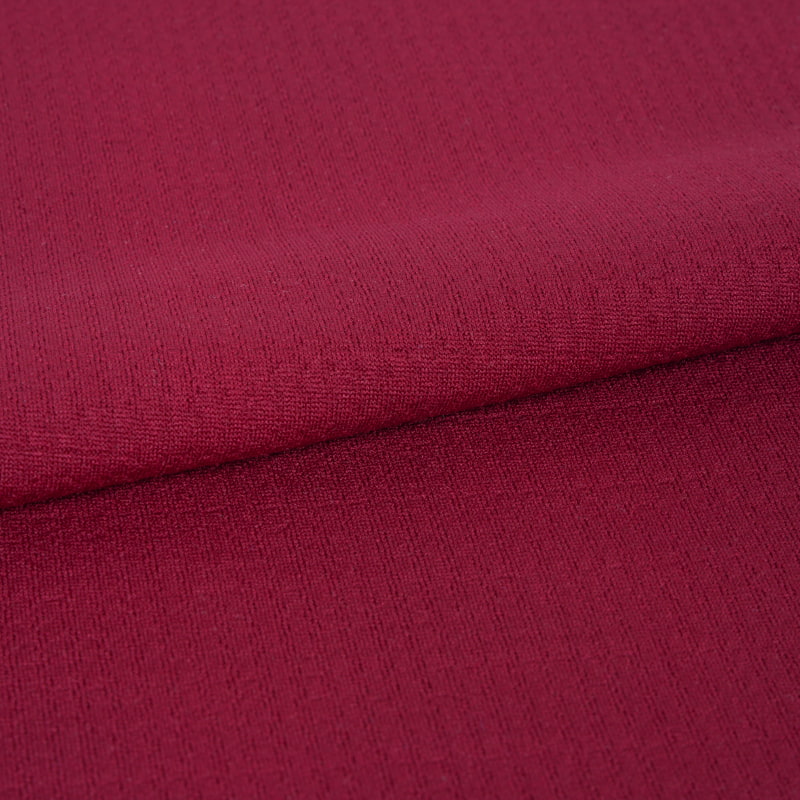
 Rayon-Spandex Stretch Sweat Knit FabricSoft rayon-spandex sweat knit offers comfortable moderate stretch for T-shirts, activewear, and close-fitting casual garments.View Product →
Pique builds a textured, slightly raised surface that lets air move and keeps the cloth from clinging, which is why it became the standard for polo shirts. Cotton pique performs particularly well in warm weather because the texture keeps fabric off the skin while the loops move moisture away from it.
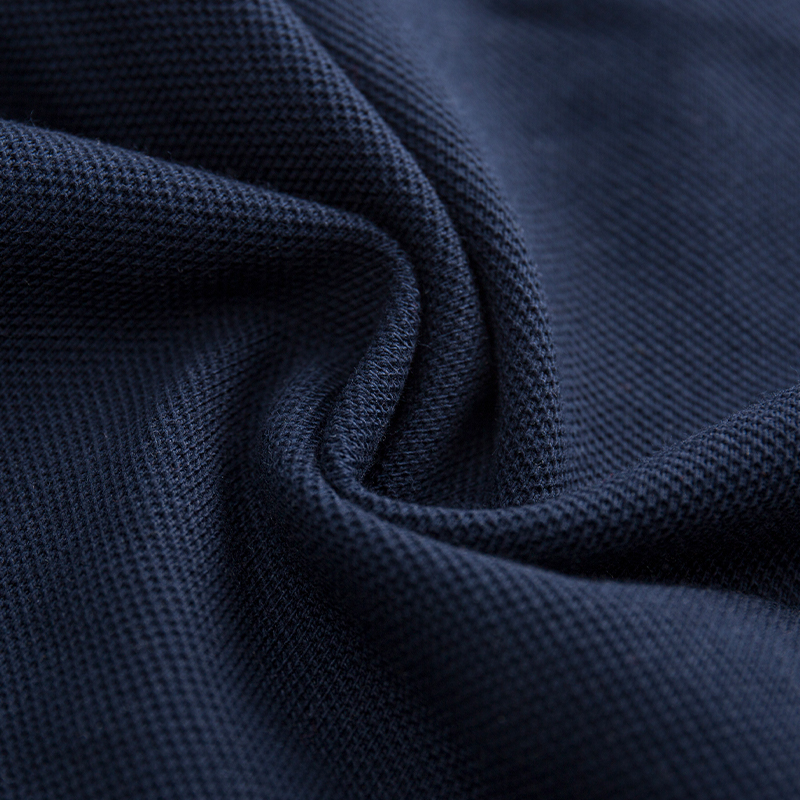 100% Cotton Pique Fabric for Polo ShirtsBreathable 220 GSM cotton pique with textured surface, moisture absorption, and shape retention; suited to polo shirts, sportswear, and casual apparel.View Product →
Rib structures such as 1x1 and 2x2 stretch sideways and snap back, making them the natural choice for cuffs, collars and waistbands. Waffle knits use a honeycomb grid to trap a little air while staying breathable, which is why they turn up in towels, robes and mid-weight tops. Terry adds loops on one or both faces for absorbency.
 Cotton Spandex Waffle Knit Fabric190 GSM cotton-spandex waffle knit with a regular grid, stable stretch, and natural cotton feel, offered for wholesale fabric supply.View Product →
Sand washing, brushing and other finishing routes work on knits much as they work on wovens: they change the surface, the hand and the shade without changing the underlying structure. If you want to see how one of these knit structures behaves in warm-weather garments, our note on cotton pique goes into the details.
For most projects the decision comes down to a short set of questions:
If the answers point to a knit, the weave vocabulary still helps, because the same logic applies. Structure, yarn and finish decide performance, in that order.
If you are working through a cotton program and are not certain whether the answer is a woven or a knit, that is a good conversation to have early, before the first strike-off. We have been producing fabric in Keqiao since 2015, and the most useful thing a buyer can send us is a clear specification together with the target garment, price point and order quantity. From there we can suggest structures, send hand samples, and tell you honestly when a woven would serve you better than anything we knit. You are welcome to browse our fabric range, or send a specification straight to our team.
Browse our fabric range to see the cotton knits we hold in production.

 Address: Xinglian Village, Fuquan Street, Keqiao District, Shaoxing City, Zhejiang Province, China.
 Phone: +86-15958501675
 Email: [email protected]
For exclusive deals and latest offers, sign up by entering your email address below.
Coprright © Shaoxing Keqiao Ruijue Textiles Co., Ltd. All Rights Reserved. Custom Jacquard Jersey Fabric Manufacturers



 English
 Español