Content
If you have ever stood in a fabric showroom and heard a cloth described, in the same breath, as both jacquard and brocade, you are not alone in feeling puzzled. Buyers ask us about this all the time, and the honest answer is simpler than the vocabulary suggests: one word describes a way of making fabric, the other describes a particular kind of fabric.
Below we walk through both, from the loom mechanism that started the whole story to the practical questions that actually matter when you are placing an order, such as how each fabric behaves, what it costs, and which one suits the product you have in mind.
Jacquard is a patterning system. It is the mechanism, and by extension the method, that lets a loom or a knitting machine control individual threads so a design can be built thread by thread instead of from a small repeating block. A jacquard fabric is simply any fabric, woven or knitted, whose pattern was produced that way.
Brocade is a fabric type. It is defined by how the pattern sits inside the cloth. An extra set of weft threads is floated across the surface to build a raised, ornamental design, usually over a smooth ground such as silk or satin. The result is decorative, slightly elevated above the ground, and generally not reversible.
That is where the famous shorthand comes from: all brocade is jacquard, but not all jacquard is brocade. Damask, matelassé, tapestry-style upholstery cloths, and the patterned knit fabrics used in sportswear and knitwear are all jacquard without being brocade. The umbrella is wide; brocade is one specific branch under it.
Until the early nineteenth century, complex patterned weaving was painfully slow. A drawboy sat above the loom and lifted warp cords by hand for every single pick. In 1804 Joseph Marie Jacquard replaced that human memory with a chain of punched cards, each card telling the loom which individual warp ends to raise for one pass of the weft. Because every end can be controlled on its own, the design no longer has to repeat within a small block. A pattern can be as deep and as detailed as the card chain allows.
That mechanism is why "jacquard" became a synonym for patterned cloth in general. If you would like the mechanics explained step by step, we keep a longer article on how jacquard fabric is made on our blog.
Brocade is older than the Jacquard machine. It was woven in China, Byzantium, and Renaissance Italy on drawlooms, and its character comes from the yarns rather than from the patterning device. A supplementary weft is introduced on top of the ground weave, floated across the face of the cloth only where the motif appears, and then either cut away or carried along the back. Those floats are what you feel when you run a finger over the surface, and they are also why the reverse side looks so different. Historic brocade often used silk ground with wrapped metallic yarns for the pattern, which is where the gold and silver shimmer of the name comes from. Today most brocade is still woven on jacquard looms, just with polyester, viscose, or blended yarns doing the decorative work.
| Point of comparison | Brocade | Jacquard (as a category) |
|---|---|---|
| What the word describes | A specific decorative fabric | A patterning technique, and any fabric made with it |
| How the pattern is formed | Supplementary weft floats over the ground cloth | Individual warp ends or needles are selected, pick by pick |
| Reversible | Usually not; floats show on the back | Depends on construction; damask jacquard is reversible |
| Surface | Raised, textured, often with a metallic or filament sheen | From flat to heavily textured, matte to glossy |
| Typical fibers | Silk, viscose, polyester, metallic-wrapped yarns | Almost anything: cotton, wool, T/R, Modal, polyester, blends |
| Weight and drape | Heavier and firmer, holds a shape well | Very wide range, from light shirting to heavy coating |
| Cost level | Higher, due to yarns, density, and slower weaving | Mid to high, driven by design complexity and fiber choice |
| Common end uses | Eveningwear, ceremonial dress, jackets, cushions, upholstery | Dresses, blouses, knitwear, activewear, home textiles |
| Care | Generally dry clean only | Follow the fiber; many jacquard knits are machine washable |
Most mix-ups come from three fabrics being lumped together. Damask and brocade are both jacquard-woven, and both often show a motif against a contrasting ground, so they look related in a photograph. In person the difference is easy to feel:
Once you know which layer of the question you are asking, the terminology stops being a trap.
There is one more piece of the puzzle that matters a great deal for anyone sourcing apparel fabric. Jacquard patterning is not limited to weaving. On a circular knitting machine, needle selection can be programmed in exactly the same spirit, so that certain needles knit, tuck, or miss on certain courses. The pattern lives inside the knit structure itself rather than floating on top of it.
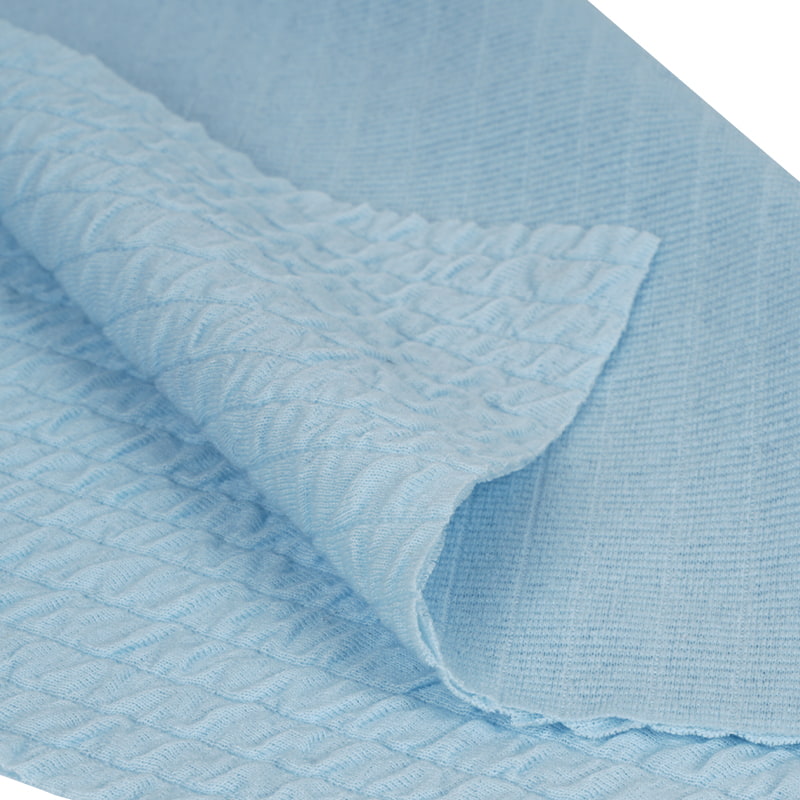 Breathable Warm 98/T 2/SP Jacquard FabricWholesale jacquard with 98/T 2/SP composition, 165cm width, and 240GSM weight; soft stretch and warmth suit autumn and winter apparel near the body.View Product →
This is the world our mill works in every day. A knitted jacquard behaves quite differently from a woven one: it stretches, recovers, and feels soft against the skin, which makes it a natural fit for sweatshirts, leggings, base layers, and casual knitwear. It is not brocade, and it is not trying to be. There is no supplementary metallic weft and no stiff, structured hand, so it solves a different problem entirely.
When a customer asks which one to use, we usually work backwards from the garment. A structured jacket, a ceremonial dress, or a cushion cover that needs to hold a sculpted shape will almost always want a woven brocade or a heavy woven jacquard. A fitted top, a pair of leggings, or a mid-layer that has to move with the body will do far better in a knitted jacquard.
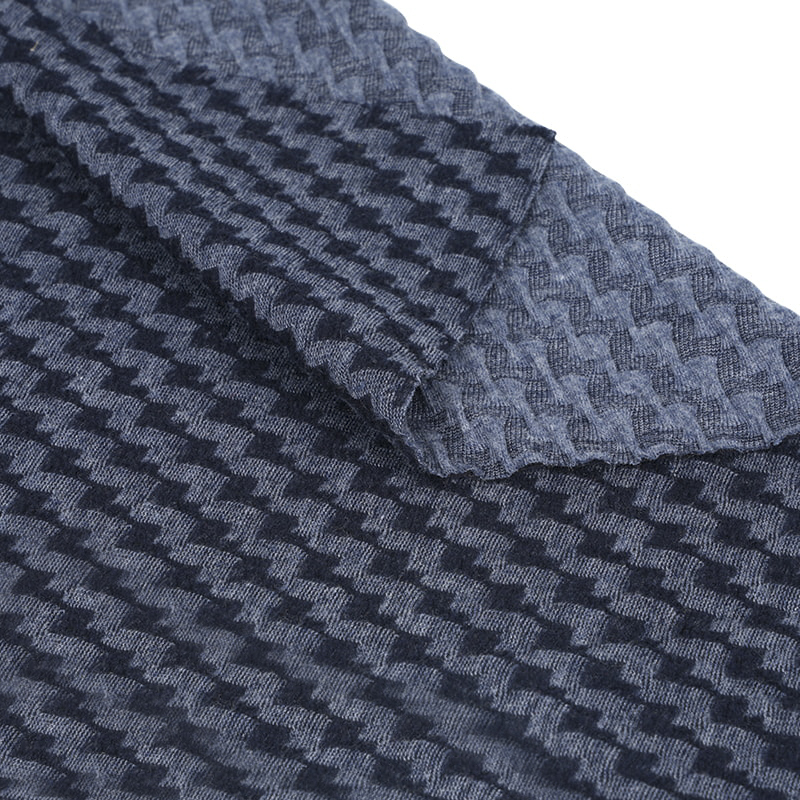 Gray Wavy 77/T 18/R 5/SP Jacquard FabricWholesale gray wavy jacquard with 77/T 18/R 5/SP, 150cm width, and 210GSM; garment applications include women's, men's, and children's dresses, shirts, and jackets.View Product →
A few practical questions tend to settle it quickly:
Brocade rewards gentle handling. The floated decorative weft snags easily on jewellery, zips, and rough surfaces, and pressing directly on a raised motif can flatten it permanently, so dry cleaning with light steaming is the safe route. Woven jacquards without raised floats are more forgiving, and their care depends almost entirely on the fiber: a polyester jacquard can often be washed, a silk one usually should not be.
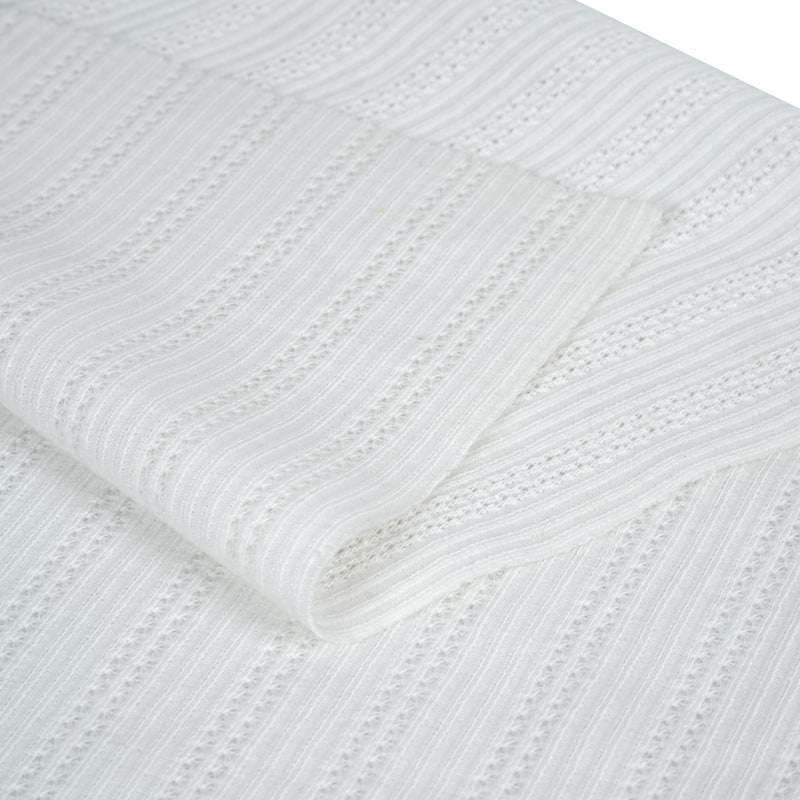 White Machine Washable 94% 6NSP Jacquard FabricWholesale white jacquard, 150cm wide and 210GSM, with 94% 6NSP composition; machine washable for convenient daily cleaning and long-term use.View Product →
Knitted jacquard is generally the easiest of the three to live with. Many of our knit jacquard qualities are built to be machine washable and to hold their shape after repeated laundering, which matters for anything sold into everyday wear. On cost, brocade sits at the top of the range because of yarn consumption and loom speed, woven jacquard sits in the middle, and knit jacquard is usually the most economical way to get a patterned surface into a garment.
Yes, in modern production. Brocade is a woven fabric with a raised supplementary-weft pattern, and it is almost always woven on a jacquard loom today. The reverse is not true: jacquard includes damask, matelassé, jacquard knits, and many other constructions.
Absolutely. Knitted jacquard is common in sportswear, knitwear, and home textiles. The patterning principle is the same, but the resulting fabric stretches and drapes quite differently from a woven jacquard.
Brocade generally costs more than a comparable jacquard because of the decorative yarns and the slower weaving. Within jacquard itself, price depends on fiber content, density, and how complex the design is.
If you take one thing away, let it be this: jacquard tells you how a fabric was made, and brocade tells you what a fabric is. Getting the two straight makes conversations with suppliers, designers, and costing teams far easier, and it helps you avoid paying brocade prices for a cloth that only needed a patterned knit.
We have spent years working across both woven and knitted patterning, and we are always happy to talk through a project before a single metre is ordered. Send us your reference, your target hand feel, and your care requirements, and we will point you toward the construction that actually fits.

 Address: Xinglian Village, Fuquan Street, Keqiao District, Shaoxing City, Zhejiang Province, China.
 Phone: +86-15958501675
 Email: [email protected]
For exclusive deals and latest offers, sign up by entering your email address below.
Coprright © Shaoxing Keqiao Ruijue Textiles Co., Ltd. All Rights Reserved. Custom Jacquard Jersey Fabric Manufacturers



 English
 Español